Last updated:
One of the earliest major incidents was the UP Board Class 12 English paper leak in 2020, after which the state government canceled the exam in several districts.
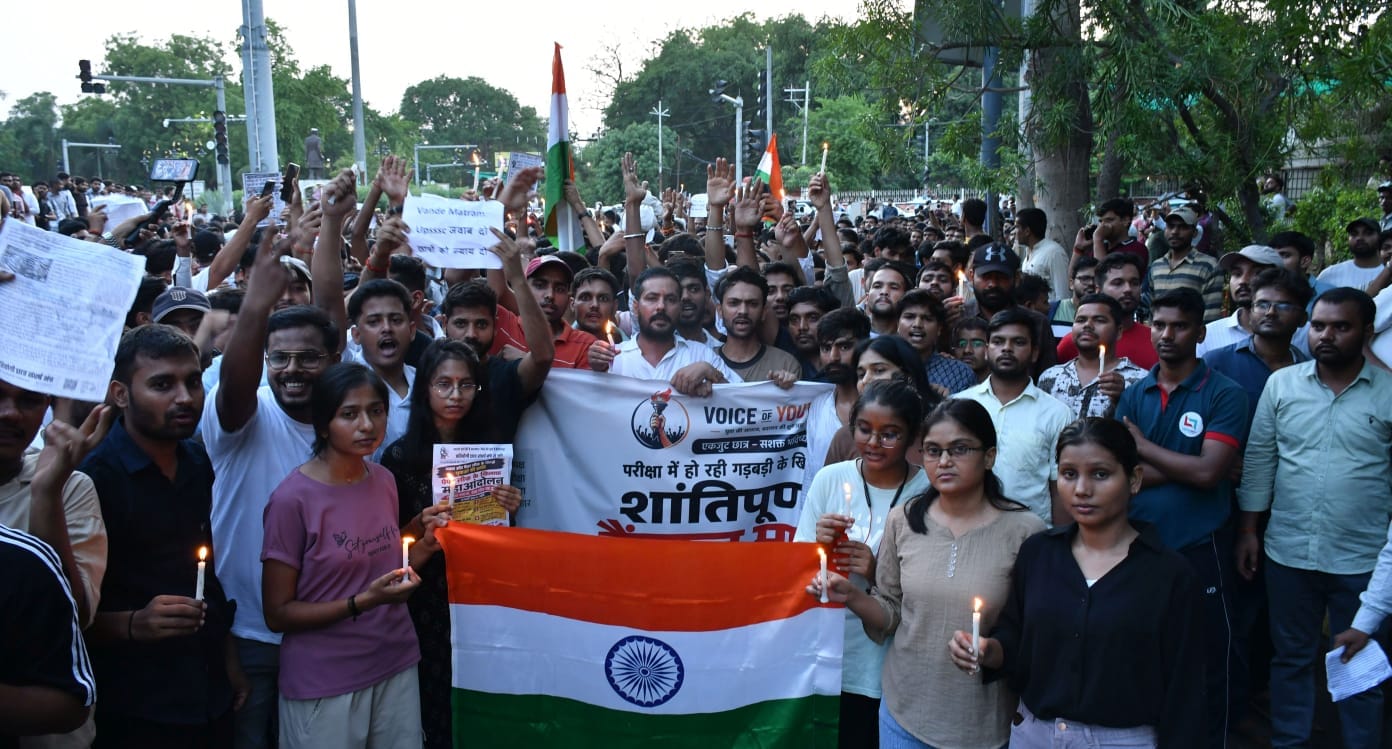
Demonstration of students in Prayagraj. (Image: News18)
“We are cockroaches. And today cockroaches are on the streets of Prayagraj. We are not against any particular paper leak here; our fight is against the system that has made our lives worse than cockroaches. We demand re-examination and a better system to stop paper leaks,” said Manish Kumar, a student who recently led a protest in Prayagraj. The protests, which many call the ‘angry exam generation’, were directed against paper leaks, recruitment irregularities and unemployment.
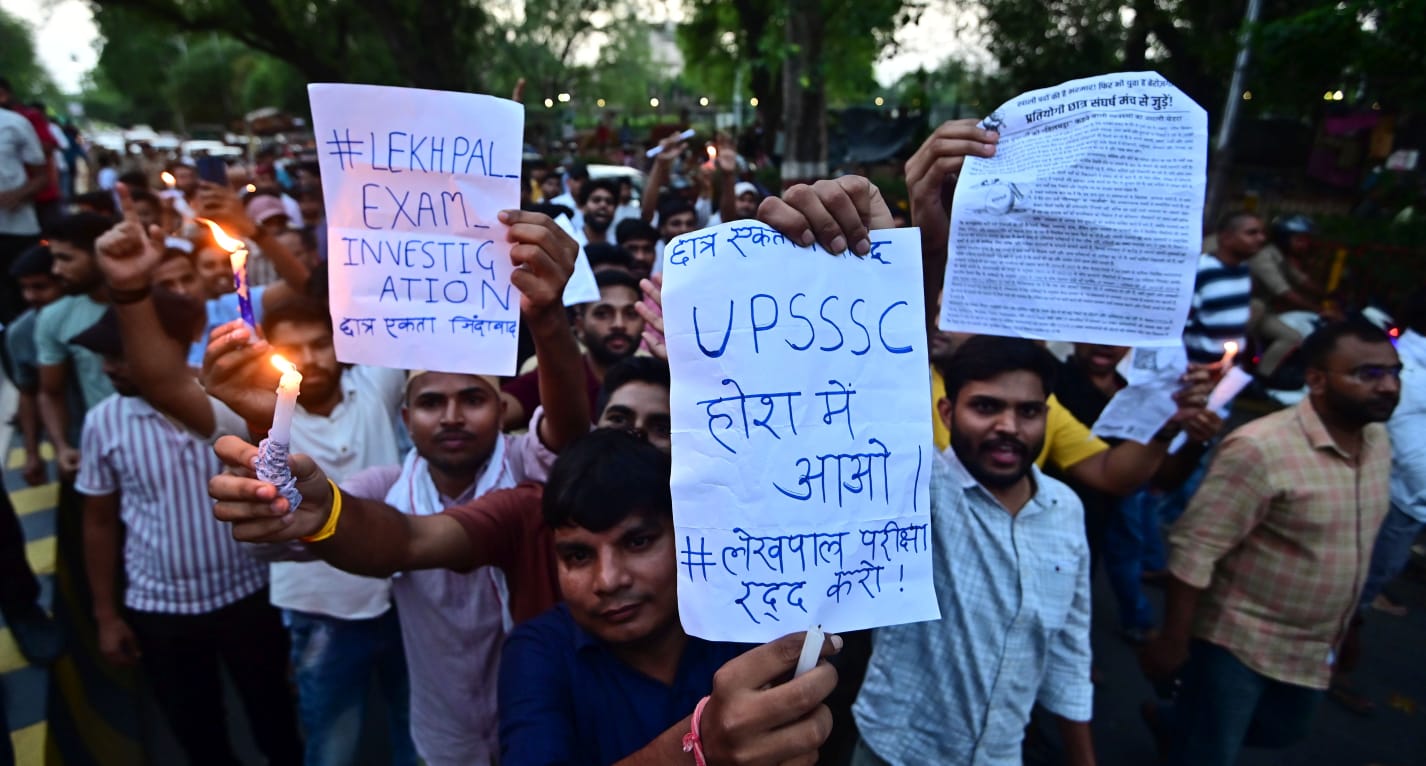
This week, hundreds of students marched in Prayagraj carrying candles and raising slogans against paper leaks, recruitment irregularities and unemployment. At first glance, the protest appeared to be another routine student movement in the coaching capital of Uttar Pradesh. But the scenes unfolding on the streets of Prayagraj point to a deeper political and social churn that political experts say is increasingly shaping the narrative among young voters across Uttar Pradesh ahead of the crucial 2027 assembly elections.
Holding placards reading “Fight the system” and “Save the future of students”, students under the banner of Joint Competitive Students Hunkar Manch marched from Manmohan Park Crossing to Chandrashekhar Azad Park in Katra, demanding action against alleged irregularities in recruitment examinations, paper leaks, delayed recruitment processes and pending vacancies. The protesters raised concerns about exams like Lekhpal Recruitment Exam, Uttar Pradesh Sub-Inspector Recruitment and issues related to SSC-GD.
This disappointment is no longer limited to the coaching streets and hostel rooms of Prayagraj. It has gradually expanded into a major youth sentiment that political parties can no longer ignore. Election Commission data analyzed during the 2022 assembly elections showed that there were more than 15 crore voters in the state, of which about 3.44 crore were in the 18-29 age group. In 2017, youth voters in the same age group were approximately 4.06 crore. Despite fluctuations in voter registration, voters under 30 remain one of the largest electoral groups in the state, accounting for about 23 percent of the electorate.
Interestingly, this number becomes even more politically significant when looked at by constituency. According to the analysis, the average number of voters in the 18-29 age group per assembly constituency was more than 85,000, while the average victory margin in the 2017 assembly elections was around 29,500 votes. In electoral terms, even a small change among young voters can change the outcome in dozens of seats.
This explains why unemployment, recruitment delays and examination controversies are no longer seen only as governance issues. These are fast becoming election issues.
Why is paper leak a matter of concern in UP?
One of the earliest major incidents was the UP Board Class 12 English paper leak in 2020, following which the state government canceled the exam in several districts after the question paper was allegedly leaked ahead of the exam.
UPTET paper leak was another major incident in 2021. Uttar Pradesh Teacher Eligibility Test (UPTET), one of the biggest teacher recruitment exams in the state, was canceled on the day of the exam after the paper was reportedly circulated through WhatsApp groups. More than 21 lakh candidates were affected. Later the examination was conducted again under tight security arrangements.
The allegation of paper leak came to light in the UP Lekhpal recruitment examination in 2022. The investigation led to arrests in several districts, with Special Task Force teams investigating organized networks allegedly involved in leaking exam material.
Similarly, the UPPSC RO/ARO exam held in February 2024 was canceled after allegations of paper leak surfaced. After protests and increasing pressure from students, Chief Minister Yogi Adityanath ordered the cancellation of the examination. Later an FIR was registered by UPPSC and the investigation was handed over to the Special Task Force. Ultimately the examination had to be re-conducted, causing a delay of about two years in recruitment.
UP Police Constable Recruitment Exam Leak emerged as one of the biggest recruitment scams in the history of Uttar Pradesh. More than 48 lakh candidates had applied for around 60,000 police constable vacancies. Investigations by the UP STF, Enforcement Directorate and other agencies later alleged the involvement of an organized interstate network.
The Assistant Professor recruitment exam was also canceled in 2025 after allegations of paper leak. The Uttar Pradesh government canceled the examination after an official inquiry found serious irregularities, including allegations related to an alleged question paper leak.
Although paper leaks were not confirmed in all cases, several recruitment exams saw allegations of irregularities, server failures, disruptions at the exam center and questions regarding transparency. These incidents gave the opposition enough ammunition to corner the ruling BJP, turning the integrity of the examination from an administrative issue to a political issue.
Many political analysts believe that anger over unemployment, paper leaks and delays in recruitments contributed to the change in youth sentiments during the 2024 Lok Sabha elections, especially in UP’s coaching centers and districts with a majority of candidates.
Cities like Prayagraj, Lucknow, Kanpur, Gorakhpur, Varanasi and Agra have developed entire local economies around government-job preparation. Coaching institutes, libraries, hostels, eating facilities, photocopy shops and stationery markets survive largely due to the aspirants of the competitive examination.
For thousands of lower-middle-class families, a government job remains the most reliable path to economic mobility. But repeated controversies involving paper leaks, canceled examinations, delays in recruitment, technical glitches and court cases have undermined confidence in the recruitment system.
How did unemployment become a major political issue in 2024?
The importance of youth discontent became visible during the 2024 Lok Sabha elections. While caste equations, welfare politics and Ram Mandir dominated the national headlines, unemployment quietly emerged as one of the most discussed issues among first-time voters, competitive exam aspirants and urban youth.
Recruitment examinations, paper leaks and vacant government posts in coaching centers of UP have become election topics again and again. Shashikant Pandey, head of the department of political science at Dr. Bhimrao Ambedkar University, Lucknow, said the BJP’s lower performance in Uttar Pradesh compared to 2019 was not only influenced by caste consolidation by the opposition, but also by growing dissatisfaction among sections of the youth over employment opportunities and recruitment related controversies.
Congress aggressively addressed unemployment in its campaign through promises related to job creation, apprenticeship support and examination transparency. The Samajwadi Party simultaneously attempted to link youth anger with its PDA (Backward, Dalit, Minority) social coalition strategy. On several occasions, Samajwadi Party chief Akhilesh Yadav accused the government of failing to fill vacancies and allowing recruitment controversies to escalate.
Meanwhile, the BJP highlighted infrastructure projects, investment summits, startup promotions and government recruitment drives. The Yogi Adityanath government has consistently said that over 8.5 lakh government jobs have been provided through transparent recruitment processes since 2017, while pointing to expressways, airports, data centers and industrial investments as long-term employment generators.
This has created a new political battlefield where both sides are targeting the same voter segment.
Recognizing the growing political weight of young voters, parties have stepped up outreach efforts. The BJP has launched an aggressive youth enrollment drive through the Bharatiya Janata Yuva Morcha (BJYM), reportedly targeting over 16 lakh new youth workers in UP through a booth-level mobilization strategy ahead of the 2027 elections. The campaign focuses specifically on voters aged 18 to 30 and aims to convert first-time voters into long-term party workers.
Along with this, Samajwadi Party has intensified its digital outreach, student engagement programs and recruitment-focused campaigns. Congress leaders have repeatedly argued that recruitment and unemployment are among the biggest concerns for the youth of UP, while smaller political groups and student organizations are increasingly attempting to build issue-based mobilization around exam transparency and employment.
However, the latest sign of this growing frustration is the viral “Cockroach Janata Party” incident. What started as a satirical online movement quickly turned into one of the hottest political trends on social media after it sparked controversy over a comment allegedly comparing unemployed youth to “cockroaches”. Although the comments later became the subject of clarification and political debate, the controversy resonated deeply among the unemployed and competitive-exam aspirants, who were already frustrated by paper leaks, recruitment delays and increasing economic pressure.
Within days, the trend accumulated millions of interactions on Instagram, X and other platforms. The language of the movement revolved around unemployment, examination scams, inflation and the youth’s frustration with the political establishment. Political analysts said its popularity reflects the emergence of a new digital political culture in which Gen Z voters increasingly express dissatisfaction through satire, memes, and viral campaigns rather than through traditional political activism.
Perhaps for the first time, unemployment, recruitment uncertainty and exam controversies have merged into a common digital vocabulary understood by millions of young Indians. This is significant because, for almost a decade, UP politics has largely revolved around Hindutva, welfare schemes, caste equations and leadership narratives.
Today in UP, students debate on caste politics as well as paper leaks. They discuss development projects as well as unemployment. Many continue to support welfare schemes while also expressing frustration with recruitment systems.
This conflict presents a challenge for every political party.
The BJP still retains significant support among sections of the youth through welfare outreach, nationalism and governance narratives. Meanwhile, the opposition is trying to turn disappointment over recruitment into a broader anti-incumbency wave.
Yet the larger issue extends beyond the election.
The repeated protests in Prayagraj, anger over paper leaks and the explosive popularity of the cockroach Janata Party tendency all point to the same underlying reality – a generation increasingly questioning whether effort alone is enough to secure opportunity.
Therefore, the candles lit during the Prayagraj march were not just a symbol of protest. They represented the growing demand for reliability, transparency and trust. And with over 3.4 crore young voters forming one of the largest electoral groups in UP, this demand is fast turning into one of the most important political questions ahead of the 2027 assembly elections.
read more