Travis Timmerman, an American from Missouri, says he was held for seven months in Syria’s infamous Sednaya prison after entering the country without permission. Timmerman, who was freed by rebels, says his time in prison was “decent,” and he was “fed well.”
A new variant of quick commerce is here in India, targeting the ones above a specific income group. Former Flipkart Senior Vice President Ayyappan R has come up with ‘FirstClub’ for the top 10% of the country’s population.
FirstClub is the new kind of quick commerce. (Representational Image)
Founded as a ‘members-only delivery startup’, FirstClub has raised $8 million in the latest round of funding, according to a MoneyControl report.
This comes at a time when the quick commerce segment has seen rapid expansion and is predicted to swell up to $40 Billion by 2030.
Major investors in the startup include Accel, RTP Global, Blume Founders Fund, Quiet Capital and 2am VC.
Flipkart co-founder Binny Bansal, Myntra co-founder Mukesh Bansal, Groww’s Lalit Keshre and Curefoods’ Ankit Nagori, who are all former colleagues of Ayyappan, also invested in the company along with Cred’s Kunal Shah and others.
FirstClub is the third quick commerce start-up that Accel has invested in after Swiggy and Swish. For 2am VC, this is the second investment in the space after exposure to Zepto.
What is FirstClub?
FirstClub will start by selling packaged foods, fresh foods, bakery, dairy, nutrition, and more and its target is the consumers who choose premium over mass-market.
The start-up will cater to largely metro city households with an annual income of over ₹15 lakh.
“These are the users, who will be willing to become FirstClub members, who don’t mind paying a 20-30 percent premium for products if they get fresh produce which are of the highest quality,” the start-up’s founder Ayyappan R said in an interview with MoneyControl.
For the first 12 months, the company will only focus on Bengaluru. Delhi and Mumbai are their next target. In the first year, FirstClub will open a total of 10 dark stores and two offline stores that will double up as experience centers as the company aims to operate as an omnichannel business.
The company will also work in the 30-minute delivery channel instead of the 10-minute one which is where the likes of Zepto and Blinkit operate.
When it’s freezing cold in the winter, all you really want to do is snuggle up in your plush blanket, drink your favorite hot mocha, and just relax in front of that room heater. But among the numerous room heaters available in the market, choosing one that gives you the right warmth and keeps your room comfortable is a difficult task. And if you have to choose between an oil filled room heater and a halogen room heater, it is sure to get confusing. But then again, we are here to help you choose between the two.
Comparison between Oil Filled Room Heater and Halogen Room Heater
Let’s understand both oil filled and halogen room heaters.
Oil filled room heater:
Oil-filled room heaters are a popular choice for providing consistent and long-lasting heat. It operates by heating oil sealed inside the unit, which then transmits the heat to the surrounding space through convection. These heaters are known for their silent operation and efficient heat retention, making them ideal for bedrooms and living spaces. Since they do not rely on open heating elements, they are safer and do not dry out the air, ensuring a more comfortable environment. While they take a little longer to heat up than other types of heaters, their steady and even heat makes them a reliable choice during the colder months.
Halogen room heaters are compact and cost-effective devices designed to provide instant heat. They use halogen-filled tubes that emit infrared radiation, which directly heat objects and people in their path, rather than the air in the room. This targeted heating makes them ideal for small spaces or personal use. Lightweight and portable, halogen heaters are energy-efficient for short-term heating, but may not be as effective for maintaining heat over long periods of time. They often feature a simple design and multiple heating settings, although their exposed heating elements require careful handling to ensure safety.
Comparison between Oil Filled Room Heater and Halogen Room Heater:
Heating Method:
Oil-filled room heaters use convection to heat the oil inside the unit, which then circulates the heat throughout the room. They provide consistent, ambient heat suitable for long periods of use. Halogen heaters, on the other hand, use infrared technology to heat objects and people directly in their line of sight, making them ideal for instant spot heating. Oil-filled heaters are better for larger areas due to their even heat distribution, while halogen heaters are more efficient for smaller, localized spaces. Overall, oil-filled heaters are better for heating an entire room, while halogen heaters excel at concentrated, short-term heat.
Halogen heaters heat up almost instantly due to their infrared technology, providing instant heat as soon as they are turned on. In contrast, oil-filled heaters take longer to heat up, because the oil inside the unit needs to be heated first before spreading heat into the room. This slow process may take 15-20 minutes to take full effect. However, the fast heat-up time of halogen heaters is best for quick, short-term heating needs, while oil-filled heaters are more suitable for continuous heating over longer periods, despite the initial delay.
Oil filled heaters retain heat well due to the high thermal capacity of the oil inside. Even after being switched off, they continue to emit heat for some time, making them energy-efficient in maintaining the room temperature. However, halogen heaters lose heat shortly after being turned off, as their heat is directly linked to their active operation. This makes oil-filled heaters a better choice for sustained heating needs and reducing electricity usage over time, whereas halogen heaters are less effective at maintaining long-term heat without continuous operation.
Security:
Oil-filled heaters are generally safe due to their lower surface temperatures and lack of exposed heating elements, reducing the risk of burns or fire. They often include features such as tip-over protection and overheat shut-off. Halogen heaters, with exposed heating elements, pose a greater risk of burns and require careful placement to avoid contact with flammable materials. Many modern halogen heaters include safety features, but they are less safe overall than oil-filled heaters, especially in homes with children or pets.
Air Dryness:
Oil-filled heaters don’t dry out the air because they use radiant heat instead of blowing hot air. This makes them ideal for maintaining a comfortable humidity level in the room. Halogen heaters, although less drying than fan-based heaters, can still reduce the humidity in the air slightly due to the heat they produce. For individuals sensitive to dry air, oil-filled heaters are a better choice, as they preserve a more natural indoor environment.
Portability:
Halogen heaters are generally lightweight and compact, making them easy to carry around and ideal for quickly heating different areas. Oil-filled heaters are bulky and heavy due to their oil-filled radiators, which can make portability more challenging, despite built-in wheels. If mobility and flexibility are priorities, halogen heaters are the more practical choice, while oil-filled heaters are better suited to semi-permanent placement in a room.
conclusion: However, both the room heaters provide enough warmth and warmth to beat the winter chill. The choice between oil filled heaters and halogen heaters depends entirely on your room size and budget. If you are looking for a room heater that will keep your large room warm for a long time, choose an oil-filled heater. On the other hand, a halogen heater can only heat a limited space or area.
More Room Heaters for you:
FAQ on Comparison between Oil Filled and Halogen Heaters
Which heater is better for quick heating?
Halogen heaters are ideal for instant heat in small, enclosed spaces or for heating specific areas.
Can I use any heater overnight?
Oil filled heaters: Yes, these are safe for overnight use due to their steady and controlled heat output. Halogen heaters: Not recommended for overnight use as they can pose a fire hazard if accidentally turned over or left too close to flammable materials.
Which heater is more cost effective?
Initial Investment: Halogen heaters are cheaper to buy. Running costs: Oil-filled heaters are more energy-efficient in the long run, leading to lower electricity bills for regular use.
Do these heaters require maintenance?
Oil filled heaters: Minimal maintenance; There is no need to refill the oil as the oil is sealed. Halogen heater: The heating elements (tubes) may require replacement from time to time.
Are these heaters safe for children and pets?
Oil-filled heaters: Yes, since the surface does not get extremely hot, making them safe. Halogen heaters: Less safe due to high heat on the surface and direct contact with the heating element.
Disclaimer: At Hindustan Times, we help you stay updated with the latest trends and products. Hindustan Times has an affiliate partnership, so we may get a share of the revenue when you make a purchase. We will not be liable for any claims under applicable laws including but not limited to the Consumer Protection Act, 2019 in relation to the Products. The products listed in this article are in no particular order of priority.
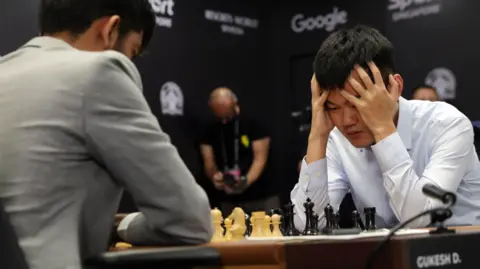
Chess grandmaster Gukesh Dommaraju of India defeated defending champion Chinese player Ding Liren
Indian teenager Gukesh Dommaraju has become the youngest-ever world chess champion after defeating defending champion China’s Ding Liren in a dramatic turn on Thursday.
Dommaraju, at age 18, is four years younger than Russian grandmaster Garry Kasparov was when he won the title in 1985 at age 22.
The Chennai prodigy has long been a superstar in the chess world, having attained the status of chess grandmaster at the age of 12.
But he was seen as the challenger going into the final of the FIDE World Chess Championship match held in Singapore this year.
EPA
Dommaraju and Ding playing in the first round of the championship last month
Playing on black, Dommaraju won the game after an under-pressure Ding stumbled made a rare mistake while in a solid position, game commentators observed.
The 18-year-old clinched victory with a final championship score of 7.5-6.5 – bringing an end to a fortnight of the two players’ matches being closely followed by chess fans worldwide.
Ding, China’s first world chess champion, had faced pressure over his form all year, ever since winning the 2023 title.
The Chinese player had not won a long-format “classical” game since January and was seen to be avoiding other top-level competitions.
But he had put in a strong opening game and won the last match against Dommaraju, suggesting momentum.
Both players had two victories apiece and eight draws going into the final game on Thursday.
After hours of tight play, Ding on move 55 moved his rook to a fatally weak position that gave Dommaraju opportunity to capitalise.
Immediately recognising his mistake Ding slumped on the table.
“Ding seemed to have a risk-free chance to push for a win but instead liquidated into a pawn-down endgame,” Chess.com wrote in its post-game summary. “It should have been drawn, but Ding blundered as the pressure grew.”
EPA
Ding reacts to his blunder
It was endgame from there on. Ding resigned three moves later.
Dommaraju promptly burst into tears as the room erupted with cheers from spectators.
“I probably got so emotional because I did not really expect to win that position,” he said according to reports.
At age 18, he is also only the second Indian player to become world chess champion, after five-time world chess champion Viswanathan Anand.
Indian Prime Minister Narendra Narendra Modi was among the first to sound his praises.
“Historic and exemplary!” he wrote on X. “Congratulations to Gukesh D on his remarkable accomplishment. This is the result of his unparalleled talent, hard work and unwavering determination.”
The FIDE World Chess Championship carries a $2.5m (£1.96m) prize fund.
BENGALURU: Bengaluru-based BlueStone Jewellery and Lifestyle, which offers contemporary diamond, gold, platinum, and studded jewellery under an eponymous brand, on Thursday filed for an initial public offering to raise Rs 1,000 crore ($118 million as per current exchange rates). The IPO also included an offer-for-sale (OFS) component for BlueStone’s investors Accel India, Saama Capital, Kalaari Capital and others. These investors are aiming to divest about 24 million shares. The OFS comprises shares up to 70,73,980 being sold by Kalaari Capital, up to 41,00,970 by Saama Capital and up to 40,00,000 by Sunil Kant Munjal and other partners of Hero Enterprise Partner Ventures. The proceeds from the fresh issue to the extent of Rs 750 crore will be used to fund its working capital requirements and general corporate purposes, the company said. Bluestone reported revenue of Rs 1,266 crore in the financial year ended March 2024, up 64% from a year ago. Net loss narrowed by 15% to Rs 142 crore. The company has raised $225 million over the years, as per Tracxn. The company was founded by Vidya Nataraj and Gaurav Kushwaha in 2011. It ships jewellery, designed in-house, across the country covering 12,600 pincodes and internationally to the United States, Canada, the United Kingdom and Australia. It also operates physical stores. As of June, 2024, the company operated 110 company-owned stores and 93 franchised stores, covering a total area of over 3,50,000 square feet. The company also operates three manufacturing facilities located in Mumbai, Jaipur and Surat, alongside a dedicated prototype facility in Mumbai that supports its designers. The company has 104 public shareholders collectively holding a 26.82% stake in its equity. Other marquee investors include Peak XV Partners, MIH Investments, Steadview, Iron Pillar, IvyCap Ventures, Access India Capital and Think Investments.
Khadar PB, 51, a textile shop owner, should by now have got a sprawling IT township with skyscrapers surrounding the waters of Kadambarayar in his neighborhood in Edachira in Kakkanad, the IT hub of Kochi.
This dream was sold to them and 57 other families who were moved out of their ancestral properties adjacent to Edachira Junction in 2008. After all these years, there are some functional IT towers standing and some in various stages of completion. The remaining land is a vast expanse of bushes and shrubs.
Their land was part of 246 acres of land leased to SmartCity (Kochi) Infrastructure Private Limited, a special purpose vehicle (SPV) jointly formed by the state government and Dubai-based Tecom Investments for the development of the SmartCity Kochi (SCK) project. ) Was. -A knowledge-based self-reliant private IT township. “We gave up seven acres of land, which was one of the largest plots acquired. It belonged to three families, whose sole ownership deed was printed on the ₹4 stamp paper of the British era. “We lived there until we moved out and started a new life on a resettlement plot right next to the SmartCity project,” recalls Khader.
The project, which had a history of massive halts since its inception nearly two decades ago, was finally shelved forever as the state Cabinet on December 4 approved the exit plan of Tecom Investments from the SmartCity Kochi project. Gave.
The smartcity project, which had a history of massive halts since it began nearly two decades ago, was finally shelved forever as the state cabinet on December 4 approved the exit plan of Tecom Investments from the project. , Photo courtesy: RK Nitin
A chief secretary-level committee recommended an exit plan based on the advice of the advocate general after Tecom reportedly wrote to the government for such an exit. The Cabinet also decided to constitute a committee comprising Director of Kerala IT Mission, Chief Executive Officer of Infopark, Kochi and Managing Director of Overseas Keralites Investment and Holding Ltd. Baju George to recommend appointment of an independent valuer for valuation . Price to purchase Tecom Investment’s 84% stake in the project. The state government owns the remaining 16%.
Kerala first heard about the project when a team from Dubai paid an informal visit in July 2004 when the Oommen Chandy-led United Democratic Front (UDF) government was in power. More formal discussions began in October that year.
Due to the war of words between the UDF and the then opposition Left Democratic Front (LDF), particularly over the proposed move to hand over Infopark Kochi to Techcom, an MoU was drawn up between the state government and the Dubai-based company. Promoted only in September 2005. SCK was one of the major campaign points in the elections for the state assembly the following year.
For the UDF camp, the state was finally getting a chance to board the IT bus with the SCK project coming into existence. Meanwhile, the LDF accused the government of selling Kerala’s assets to a foreign entity in the name of development. LDF won the election and VS Achuthanandan was sworn in as Chief Minister in 2006.
“The previous UDF government had proposed to give 200 acres of land to Tecom besides Infopark Kochi, out of which 100 acres was to be given free of cost for real estate with a guarantee of 33,300 jobs. “We reworked the agreement and put the onus on Tecom to build 88 lakh sq ft with a ceiling of 70% for IT and create 90,000 jobs in 10 years,” says Joseph C. Mathew, IT advisor to Chief Minister VS Achuthanandan. Made it mandatory.”
Thus the original Framework Agreement was signed in May 2007. A grand foundation stone laying ceremony was held on 16 November. Moss remained on that stone for almost a decade and the project was refusing to start. The meetings of the Board of Directors lasted for hours as the project faced one hurdle after another.
Even the registration of the lease agreement took almost three years as the registration department refused to exempt it from stamp duty, around ₹50 lakh, although the project received Special Economic Zone (SEZ) notification in principle. Was. The file, which was referred by the then Ernakulam District Collector, remained gathering dust in the Finance Department until 2011, when the lease agreement was finally registered with stamp duty exemption.
Tecom then demanded freehold rights, even full rights to sell the land, on the basis that multinationals would not invest in the subleased land. The government agreed to grant freehold rights on specific plots subject to the condition that it should not exceed 12% of the total land, after which Tecom lost interest in the process. The issue of not receiving a single SEZ notification for the entire 246 acres due to a reservoir passing through the project site was finally resolved in 2013.
In fact, as the project was facing inordinate delays, Achuthanandan asked Tecom to leave the company if it had no interest in the project. Industrialist Yusuf Ali was inducted into the board of directors of SCK at the same time and a meeting of stakeholders was held in 2011 to resolve the issues. By that time it was too late. In the second consecutive election, in which the SCK project was a major campaign issue, the Oommen Chandy-led UDF returned to power, albeit with a much reduced majority.
Construction work on the first phase began in July 2013. After much delay, the first IT tower of the 6.50 lakh sq ft SCK project was inaugurated with much fanfare on February 20, 2016, at the end of the Chandy government. LDF boycotted the inauguration ceremony alleging lack of transparency and corruption.
Construction of the second phase of 4.7 million square feet spread across seven towers and creating 60,000 jobs was also launched on the occasion with a promise of commissioning in 36 months. Even after eight years the promise remains unfulfilled. Since then only one more IT tower has been commissioned by the co-developer, while projects of other co-developers are in various stages of completion.
SCK’s only IT tower hosts 27 IT and ITES companies catering to around 5,500 jobs. “When other government IT parks gave rent relaxation during the pandemic, SCK did not give anything. We formed the SmartCity Investors Forum and approached the government several times since 2020 demanding that SCK be brought under Infopark Kochi,” says Derrick Sebastian, who will join SCK in 2022 after spending just four years in the IT tower. Transferred his software company back to Infopark.
SCK officials could not be contacted for comment. However, its website claims that it brought in or facilitated investments of ₹2,609 crore, of which ₹1,935 crore was under various stages of construction by its seven co-developers. It further claimed that “58 lakh sq ft of additional space will be delivered in phases starting from October 2020”.
SCK’s already sinking fortunes were dealt a fatal blow when Tecom’s parent company Dubai Holdings decided to suspend its operations and projects outside Dubai in 2017. The SCK office in Dubai was closed in the same year. “The fate of the project was decided then and there. Only that the government has now decided to act,” says an official who was previously associated with the project.
The Cabinet decision to accelerate the project has now brought it back into the limelight. Opposition leader VD Satheesan accused the government of allegedly planning to distribute 246 acres of valuable land to real estate barons close to the Communist Party of India (Marxist) and provide relief to Tecom through ‘compensation’. The company which was at fault. Senior Congress leader Ramesh Chennithala questioned the inclusion of Baju George, who had represented Tecom in the past and served as SCK CEO, in the three-member committee recommending the independent evaluator.
Chief Minister Pinarayi Vijayan and Industries Minister P. Rajeev accused the opposition of running a misinformation campaign and said the word ‘compensation’ was wrong. The Chief Minister clarified that there is no compensation involved, but steps are being taken to buy out Tecom’s stake in the project, as proposed in clauses 7.2.1 and 7.2.2 of the Basic Framework Agreement. “There are no plans to start joint ventures with private companies. Future development will be under the complete control of the government,” he said.
In the event of default on the part of Tecom, the framework agreement gives the government the right to terminate the lease and purchase the entire shareholding of Tecom at a price determined by an independent valuer, while the land is valued at ₹91.52 crore. Which was the advance lease premium paid by SCK to the government for 88% of the land. In other words, the valuation of land will not be considered in any purchase or sale.
The government decided to adopt a mutually agreed exit policy for TECOM on the grounds that arbitration under the Arbitration and Conciliation Act of 1996 would take time, leaving the land out of use for a long time. A government law official says, “However, a specific clause in the agreement that it will be governed, interpreted and enforced in accordance with the laws of India limits Tecom’s scope to apply UAE laws in arbitration. Is.” Condition of anonymity.
Not everyone is mourning the end of the project; Some want the land to be used for the third phase expansion of Infopark Kochi, which is facing land shortage. “While the SmartCity has created only about 5,000 jobs, the Infopark in the neighborhood has created 70,000 jobs during the last decade. In fact, Techcom should have been asked to exit at least five years ago,” says Anish Panthalani, president of IT workers’ group Progressive Techies.
The government emphasizes that the goals behind the SmartCity Kochi project will not be abandoned, and the government will intervene in the matter to facilitate information technology development in Kerala. Referring to the proximity of the SCK land to the Infopark, the Chief Minister said, “The future course of action is yet to be decided.”
Infopark is exploring other avenues including land pooling for its third phase expansion. But she will not make any demand for SCK land. “This is a policy decision to be taken by the government,” say Infopark officials.
There are reports that the Kerala State Electricity Board Limited, which had given up 100 acres of land for the project, is planning to ask for it back. However, the Power Minister’s office will not confirm any such plan at this time.
Founder and CEO of Technopark G. Vijayaraghavan cites the ill-fated SCK as a classic example of how opportunity never waits for anyone. “Not getting things done on time means missing opportunities. And when an opportunity is lost, look for a new one, but with timely amendments,” he says.
Meanwhile, Khader rues that people like him have become losers due to having to give up land, which is now worth between ₹15 to ₹25 lakh per cent. It was acquired at a maximum price of ₹84,000 per cent. “What was all this drama for?” He wonders.
‘Invisible’ refugee children trapped in Europe’s migration red tape
More unaccompanied children are coming to Europe
,
Children on the move lack safe routes, emergency assistance
,
Family reunions and parenting networks face delays
By Beatrice Tridimas
TRIESTE, Italy, – As quietly as they had come, on a cold winter evening, three teenagers ran through a shady station in the northeastern Italian city of Trieste, pursued by a member of a smuggling gang who was barely older than them. .
Less than 100 kilometers from the Italian border with Slovenia, Trieste’s central station was just a short stopover on the boys’ long journey from their homes in Egypt.
At the station, in the square overlooking the Plaza Della Libertà, officials from international and local NGOs brought pizza and warm coats to the boys, two of whom are 14 and one 15. There was nothing else they could do.
Throughout the night, volunteers teamed up with officials at the square to provide food, clothing and first aid to the migrants, many of whom are under the age of 18 and traveling without a parent or legal guardian.
In the first nine months of 2024, arrivals of unaccompanied children in Bulgaria, Cyprus, Greece, Italy, Malta and Spain, the main EU entry points, were 8% higher than in the same period in 2023, with arrivals slowing overall. Despite data compiled by the United Nations children’s agency UNICEF.
At the end of September, there were 22,489 unaccompanied and separated children in five countries.
And as more people arrive, human rights groups warn that Europe is not adequately equipped to help them.
An 18-year-old Afghan, who gave his name as Omid, which means hope, arrived in Trieste late on November 1 aboard a freight train carrying grain between Serbia and Italy.
With grain still in his pockets, he was playing cards at the station with a group of people he had traveled with, waiting for the first train from Trieste to Venice at 4:26 am.
He said he spent 13 days wandering around Bulgaria without food and was chased and beaten by police.
“They hit us with sticks, kicked and punched us. If you moved, the dogs would bite you,” said Omid, who fled Afghanistan and declined to give his full name for security reasons.
Omid said he covered most of his journey on foot with 23 other Afghans. He said they have no future in Afghanistan under Taliban rule.
Between July and September, the International Rescue Committee helped an average of 11 newly arrived unaccompanied children every day in Trieste. More than half were boys from Afghanistan.
As of January 2022, 83% of the children the IRC has helped were Afghans.
When they arrive, the exhausted teens need practical help — new shoes, socks, first aid for their bloody and blistered feet, cold medicine, and ways to sleep, shower, and charge their phones. Place for.
Most people only stay a night or two before moving on.
With no place to stay, many people sleep on the streets under emergency blankets, have no access to toilets and risk having their phones taken away or becoming victims of traffickers looking to exploit them.
“They are invisible to everyone except us,” said Alessandro Pepes, manager of the IRC’s Trieste operations.
At 1 am, the railway station closed and Omid and his group sought shelter from the icy wind in a nearby bus garage, grateful for the shoes, coats and blankets given to them.
numbers are increasing
According to UNICEF, violence, conflict and human rights violations have contributed to a dramatic increase in the number of forcibly displaced children around the world since 2020.
In Europe, 46,500 unaccompanied or separated children are expected to apply for asylum in 2023, more than double the number in 2020.
According to EU data, the largest number of first-time applicants for international protection among unaccompanied minors were from Syria, followed by Afghanistan. In 2023, 13,570 unaccompanied Syrian children applied for international protection.
Many European countries blocked asylum applications from Syrians after the fall of President Bashar al-Assad in December. Children and adults can still apply, but their applications will not be examined until the situation is clear.
The exact number of children traveling alone in Europe is unknown, as many do not register upon arrival and continue on the move.
Local authorities in Italy are only responsible for managing the arrival of children if the children choose to stay, Pepes said.
Unaccompanied children who register with the police are accommodated in official reception centres. But children who do not register miss out on access to state-run services and their rights.
The IRC is raising funds to open an emergency shelter in Trieste specifically for unaccompanied minors.
According to the IRC, often children are traveling to a country where they have friends or family, or they do not want to be separated from the groups they came with.
In the Plaza Della Libertà, volunteers and officials from the IRC, Save the Children and the UN refugee agency UNHCR provide children with information about their rights and the asylum process, or how to buy and validate train tickets for the next leg of their journey. Provide information about do. ,
Of the 6,501 unaccompanied minors the IRC has helped in Trieste since 2022, 84% said they planned to move on.
“They always have enough motivation to reach out to other countries, so it’s impossible to keep up with them, even though it would be better for some of them,” Pepys said.
no safe route
Terry Smith of the European Guardianship Network said children often face violence and danger or are exploited by traffickers during the journey to Europe, which sometimes takes years. said Terry Smith of the European Guardianship Network, an organization working to improve services for unaccompanied minors in the EU.
Itinerant children need a legal pathway, Smith said.
“We can’t do that because the system doesn’t exist.”
Children who apply for asylum in their first country can legally move to another Member State by requesting to transfer their application to a country where they can have family.
But strict legal considerations and inconsistent standards between countries make it a long, complex and inefficient process.
Figures from the European Council on Refugees and Exiles show that only 2% of relocation requests in 2022 were based on family reunification.
In Greece, where arrivals of unaccompanied children have doubled compared with last year, application deadlines are often missed because other EU states require time-intensive DNA tests to prove family ties, said Lora Pappas, director of Metadrasi, a Greek NGO that works with migrants and refugees.
Doubt on new agreement
A new European migration agreement will allow applications by unaccompanied children for family reunification to be submitted after the official deadline.
But in November, the IRC and 28 other humanitarian organizations signed a joint policy brief calling for stronger protection measures for children in the agreement and resources to support them.
The agreement on migration and asylum will come into force from 2026. Member states must submit plans to implement the rules by 12 December.
The agreement aims to strengthen solidarity among EU members, as irregular migration has become an increasingly fraught political issue and states have a trade responsibility for arrivals.
This includes measures to strengthen screening processes and prevent secondary movement between countries to help establish which countries are responsible for handling applications.
But rights groups said governments need to support the measures with funding and training to ensure children’s vulnerabilities are not overlooked during screening and processing at borders.
“This agreement is a missed opportunity when it comes to child protection,” said Laetitia Van der Venet, an expert at the Forum for International Cooperation on Undocumented Migrants, a signatory to the policy briefing.
The agreement requires the appointment of a permanent guardian within 15 days of applying for asylum in an EU member state.
Eleonora Testi, ECRE’s legal expert, said, “Guardianship services are understaffed, underfunded and do not have enough people to be able to meet the needs of minors. Without changing this, it will be impossible to respect.”
‘What should I do?’
Ahmed, a 17-year-old from Afghanistan, said he has been waiting for more than six months to be appointed a guardian before moving forward with his asylum application.
While living in a reception center for unaccompanied minors in Trieste, he comes to a day center for local homeless people run by the church charity San Martino al Campo and used by the IRC to support migrants, so that he can find his Could spend time with old friends.
Ahmed’s 18th birthday is approaching and he fears he will have to leave the reception centre.
“I only have two and a half months, what should I do?” asked Ahmed, who preferred to be identified by a pseudonym. “Maybe they’ll kick me out and I’ll sleep on the street.”
Ahmed hoped that if he was granted asylum his father could join him from Afghanistan.
Carla Garlatti, Italy’s independent charity for children and teenagers, is calling on more than 20,000 parents to become volunteers.
He said administrative processes should be faster and parents should be trained to help integrate children.
“For minors arriving in Italy without accompanying adults, the voluntary guardian figure represents a fundamental resource in the welcome and integration process,” Garlatti said in an email.
The authority has received 4 million euros from the EU Asylum, Migration and Integration Fund for two programs dedicated to promoting foster care for unaccompanied minors and assisting volunteer guardians in fulfilling their role.
‘More work needed’
Rights groups are also concerned that the new migration deal could increase the risk of children being detained at borders.
Unaccompanied minors flagged as security threats will be subject to a new border procedure, which will mean they will be held at borders during the application process, potentially in detention-like conditions and without access to appropriate support.
A spokesperson for the European Commission Department for Migration and Home Affairs said, “Detention should only be used as a last resort, for the shortest possible time, and never in prison accommodation or any other facility for law enforcement purposes.” Should not be done.”
The spokesperson said minors under the age of 12 or with special reception needs should be excluded from these procedures.
Anna Knutzen, child protection specialist at UNICEF, said, “We want to see more safeguards, ensuring that children are not held in closed facilities, and that they have access to protection systems and education while going through any type of border process.”
Knutzen said member states should be very specific in the definition of terms when making their own laws to avoid broad application of the rules.
Knutzen said more work needed to be done to improve conditions in reception centers and ensure children have access to legal pathways.
Meanwhile, without the support they need, children and teens face difficult choices.
Ahmed said he had nothing to do in Italy and wanted to move on. He said it would cost 3,000 euros to travel to Britain and he would have to risk his life to cross the Channel.
This article was generated from an automated news agency feed without any modifications to the text.
New Delhi: A nearly 26 per cent rise in FDI to USD 42.1 billion during the first half of the current fiscal year 2024-25 helped India’s gross foreign direct investment (FDI) inflows reach an impressive USD 1 trillion since the start of this century.
India has achieved a remarkable milestone in its economic journey, with gross foreign direct investment (FDI) inflows reaching an impressive USD 1 trillion since April 2000. This landmark achievement was helped by a nearly 26 per cent rise in FDI during the first half of 2024-25.
Ministry of Commerce and Industry in a statement asserted that such growth reflects India’s growing appeal as a global investment destination. “FDI has played a transformative role in India’s development by providing substantial non-debt financial resources, fostering technology transfers, and creating employment opportunities.”
“Initiatives like ‘Make in India’, liberalised sectoral policies, and the Goods and Services Tax (GST) have enhanced investor confidence, while competitive labour costs and strategic incentives continue to attract multinational corporations,” the Commerce Ministry said.
Over the last decade (April 2014 to September 2024), total FDI inflows amounted to USD 709.84 billion, accounting for 68.69 per cent of the overall FDI inflow in the past 24 years. To promote FDI, the government has put in place an investor-friendly policy, wherein most sectors, except certain strategically important sectors, are open for 100 per cent FDI under the automatic route.
Further, to simplify tax compliance for startups and foreign investors, the Income Tax Act, 1961 was amended in 2024 to abolish angel tax and to reduce the income tax rate chargeable on the income of a foreign company.
As India continues to align with global economic trends, the government believes it is well-positioned to further strengthen its role on the global stage, fostering sustainable growth and development.
When United States President Ronald Reagan and his Soviet counterpart Mikhail Gorbachev met in Geneva in 1985 they agreed “A nuclear war cannot be won and must never be fought.” It was the prelude to the beginning of the end of the Cold War nuclear arms race and subsequent deep cuts in American and Soviet – later Russian – arsenals.
Since then, the original five nuclear weapons states have reaffirmed this statement, most recently in 2022.
But some disagree and hark back to the military strategies of the 1950s that envisaged the use of nuclear weapons by troops on the battlefield to win wars. A recent example is former Trump administration official, David Lasseter, who argued “the Department of Defense (DoD) is not doing nearly enough to ensure the American warfighter is able to fight, survive, and win on a nuclear battlefield”.
The timing of such comments could not be more inopportune: as the Nobel Peace Prize is about to be awarded to Nihon Hidankyo – an organisation of hibakusha, the survivors of the US bombings of Hiroshima and Nagasaki – for their lifelong campaigning for the elimination of nuclear weapons.
The 1945 atomic bombs that killed more than 200,000 people in Japan would today be called “tactical” nuclear weapons. The survivors of those “tactical” nuclear weapons are the real experts on what nuclear war means. They crawled through the rubble of the world’s first, and thankfully only, nuclear war. It is cynical indeed for armchair warriors, particularly those with ties to the companies building nuclear weapons, to advocate strategies based on unproven theories, not real-life experience.
The hibakusha alive today were children when their cities were devastated by American atomic bombs 80 years ago. Their average age is now 86.
Sumiteru Taniguchi, who died in 2017, was 16 years old when Nagasaki was attacked. At the time of the explosion, he was riding his bicycle. “In the flash of the explosion,” he recounted, “I was blown off the bicycle from behind and slapped down against the ground.” When he lifted his head, he saw that the children who had been playing all around him just moments before were dead.
He suffered severe burns and his wounds quickly became infected. He spent almost four years in hospital recovering from his injuries, including 21 months lying on his stomach. He had to have 10 surgeries later in life to remove growths from the scarred areas of his body. The pain and discomfort from the injuries never went away.
It is estimated that 38,000 children were killed in the attacks on Hiroshima and Nagasaki. The fact that so many children were killed, maimed and harmed in other lingering ways in the attacks motivated the survivors, like Taniguchi, who served as chair of the Nagasaki Council of A-Bomb Sufferers for many years, to devote their lives to working to ensure no one ever again has to suffer as they did.
The testimony of the survivors graphically shows that the idea that nuclear war can be fought and won on the battlefield is dangerous, grotesque nonsense that makes nuclear war more likely. As Annie Jocobsen’s recent book Nuclear War: A Scenario made clear, the use of a nuclear weapon would quickly escalate and result in a major exchange that would not just kill tens or hundreds of thousands near the explosions, but would end the world as we know it in a matter of minutes. It would cause a nuclear winter that would lead to the collapse of food production, famine and the deaths of billions of people. The impact on global biodiversity and the economy is nearly impossible to imagine.
In response to nuclear threats that Russia has made during the Ukraine conflict, the co-chair of Nihon Hidankyo, Terumi Tanaka, who was 13 when Nagasaki was bombed, says the use of nuclear weapons would spell “the end of the human race” and that leaders like President Putin “don’t realise the extent of the damage that can be done”.
The leaders of all the nuclear-armed countries need to ignore the siren voices that tell them nuclear war can be fought and won and instead listen to the hibakusha who are urging them to eliminate their arsenals before it is too late.
After Nihon Hidankyo was told it had won the Peace Prize, another of its co-chairs, Toshiyuki Mimaki, from Hiroshima, said the award would help bring the end of nuclear weapons closer, saying, “It would be a great force to appeal to the world that the abolition of nuclear weapons can be achieved … Nuclear weapons should absolutely be abolished.”
The hibakusha achieved a major step towards this goal when they played a leading role in the creation of the United Nations Treaty on the Prohibition of Nuclear Weapons, the TPNW. The treaty bans nuclear weapons and all activities associated with them outright. It came into force in 2021 and half of all countries have already signed or ratified it.
The TPNW provides the pathway under international law for all nuclear-armed states to get rid of their weapons. This year’s Nobel Peace Prize underlines that the governments of these countries have no more excuses – they should listen to Nihon Hidankyo and the hibakusha, join the treaty and eliminate their arsenals.
The views expressed in this article are the author’s own and do not necessarily reflect Al Jazeera’s editorial stance.
When it comes to choosing the right geyser for your home, Orient Electric offers a wide range of options to suit every need. Whether you are looking for an instant geyser or a storage geyser, Orient Electric has the perfect solution for you. In this article, we will compare the top 8 Orient Electric geysers available on Amazon to help you make an informed decision. From installation types to capacity and warranty, we’ll cover everything you need to know to find the best geyser for your home.
Experience reliable hot water with Orient Electric Geysers.
Orient Electric Installations Instant Water Heater is a convenient and reliable option for instant hot water. With an attractive design and easy installation, this geyser is a perfect fit for any modern home. It comes with a warranty for added peace of mind.
Specifications of Orient Electric Installation Instant Water Heater
Capacity: 3 liters
Installation Type: Vertical
Warranty: 2 years
Material: Glassline
Compatibility: Tall buildings
reason to buy
reasons to avoid
sleek design
limited capacity
easy installation
Orient Electric Glassline Instant Water Heater is designed for high rise buildings and provides quick and efficient hot water. With a durable glasslined tank and high-altitude compatibility, this geyser is a great choice for modern homes.
Specifications of Orient Electric Glassline Instant Water Heater
Capacity: 10 liters
Installation Type: Vertical
Material: Glassline
Compatibility: Tall buildings
reason to buy
reasons to avoid
large capacity
May require professional installation
durable tank
Orient Ultra Diamond Glassline Instant Water Heater is designed for high rise buildings and provides quick and efficient hot water. With a durable glasslined tank and high-altitude compatibility, this geyser is a great choice for modern homes.
Specifications of Orient Ultra Diamond Glassline Instant Water Heater
Orient Electric Aquator+ 25L Storage Water Heater features a 5 Ultra-Diamond Glassline coated tank for durability. Ideal for high-rise buildings, it offers a 7-year tank warranty, ensuring long-lasting performance. Enjoy free installation and connecting pipes, making it a convenient and reliable hot water solution.
Specifications of Orient Ultra Diamond Glassline Instant Water Heater
Capacity: 25 liters
Installation Type: Vertical
Material: Glassline
Compatibility: Tall buildings
reason to buy
reasons to avoid
extra large capacity
May require professional installation
durable tank
Orient Ultra Diamond Glassline Instant Water Heater is designed for high rise buildings and provides quick and efficient hot water. With a durable glasslined tank and high-altitude compatibility, this geyser is a great choice for modern homes.
Specifications of Orient Ultra Diamond Glassline Instant Water Heater
Capacity: 35 liters
Installation Type: Vertical
Material: Glassline
Compatibility: Tall buildings
reason to buy
reasons to avoid
extra large capacity
May require professional installation
durable tank
The Orient Electric Rapidus Instant Water Heater is a compact and efficient option for instant hot water. With a fast heating system and durable design, this geyser is perfect for small spaces.
Specifications of Orient Electric Rapidus Instant Water Heater
Orient Electric Strength Polymer Instant Water Heater is designed for high rise buildings and provides quick and efficient hot water. With a durable polymer tank and high-altitude compatibility, this geyser is a great choice for modern homes.
Specifications of Orient Electric Strength Polymer Instant Water Heater
Capacity: 10 liters
Installation Type: Vertical
Material: Polymer
Compatibility: Tall buildings
reason to buy
reasons to avoid
durable tank
medium capacity
high growth compatibility
The Orient Electric Fontas Storage Water Heater is a reliable and efficient option for consistent hot water. With a large storage capacity and durable design, this geyser is perfect for larger homes.
Specifications of Orient Electric Fontas Storage Water Heater
Orient Ultra Diamond Glassline Instant Water Heater
15 liters
standing
glassline
Orient Ultra Diamond Glassline Instant Water Heater
25 liters
standing
glassline
Orient Ultra Diamond Glassline Instant Water Heater
35 liters
standing
glassline
Orient Electric Rapidus Instant Water Heater
6 liters
standing
polymer
Orient Electric Strength Polymer Instant Water Heater
10 liters
standing
polymer
Orient Electric Fontas Storage Water Heater
25 liters
standing
glassline
Best value for money Orient Electric Geysers:
Orient Electric Installation Instant Water Heater offers the best value for money with its compact design, fast heating and durable glasslined tank. This is the perfect choice for those looking for a budget-friendly and efficient geyser.
Orient Ultra Diamond Glassline Instant Water Heater comes out as the best overall product with its extra large capacity, durable tank and high-rise compatibility. It is a perfect choice for large houses and modern homes.
Factors to Keep in Mind While Choosing the Best Orient Electric Geyser:
Capacity: Choose a geyser of appropriate capacity depending on the size of your house to ensure adequate hot water.
heating technology: Consider models with advanced heating technologies like copper or glass-lined tanks for faster and more efficient heating.
energy efficiency: Look for energy-efficient Orient Electric geysers with high star ratings to reduce power consumption and lower bills.
safety features: Select geysers with built-in safety features like automatic cut-off, pressure release valve and thermal protection.
Tolerance: Choose geysers made from corrosion-resistant materials like stainless steel or glass-lined tanks for long life.
All Orient Electric geysers come with a 2-year warranty for peace of mind.
Do these geysers require professional installation?
Some geysers may require professional installation, especially for high-rise buildings.
What is the capacity range of Orient Electric geysers?
Orient Electric geysers are available in capacities ranging from 3 liters to 35 liters to suit various household needs.
Are these geysers energy-efficient?
Yes, Orient Electric geysers are designed to be energy-efficient, providing hot water while saving electricity costs.
Disclaimer: At Hindustan Times, we help you stay updated with the latest trends and products. Hindustan Times has an affiliate partnership, so we may get a share of the revenue when you make a purchase. We will not be liable for any claims under applicable laws including but not limited to the Consumer Protection Act, 2019 in relation to the Products. The products listed in this article are in no particular order of priority.